

The Ruckus is a new, lightweight paddle designed specifically for racing available in two blade sizes.
Hydrus Ruckus Flyweight: Overview
Hydrus has been on a tear recently developing high-quality SUP racing equipment with the goal to get more people moving fast on the water. First the Elysium Air racing SUP that made me ditch my carbon fiber race board. Then a pair of pre-preg carbon fiber fins designed for technical racing racing (the Katana 2.0) and for performance distance paddling (the Riptide), and now the new Ruckus Flyweight paddle – which is available in two different blade sizes, two different handle sizes, and as a one- or two-piece paddle (both are cut-to-length, not adjustable).
Like with the Elysium Air, Hydrus has once again made me question why I spent so much money on a different product! The Ruckus has become my new racing paddle for sure. Read on to find out why.
Save 10% with code “BOARDER” at checkout
Hydrus Ruckus Flyweight: Construction & Specs
Hydrus began working on the Ruckus paddle to create a high-performance paddle for racing that would be as user-friendly and wallet-friendly as possible, especially compared to other popular race paddle options.

The Ruckus Paddle uses 30T carbon fiber for a light, responsive, and quality build.
Construction
The Ruckus is built with preimpregnated (pre-preg) 30T carbon fiber through both the paddle shaft and paddle blade. Pre-preg carbon fiber means the manufacturer of the carbon fiber fabric itself coats the carbon with the exact amount of epoxy resin required to give the carbon fiber a perfect cure that maximizes strength while minimizing weight.
That prepreg carbon is then placed in a vacuum mold (for the blade) or wrapped on a mandrel (for the shaft) and cured in a specially designed oven at high heat. The shaft has a slight taper, becoming narrower near the handle, to help give it a little more flex while paddling.
It is possible to create paddles with less resin, resulting in a lighter paddle, but the risk and tradeoff is in reliability. A section of carbon fiber that doesn’t get enough resin will become brittle and easily break.
The “30T” (T for tensile strength in Tons) material refers to the modulus strength and stiffness of the carbon fibers themselves. Higher Tonnage materials can reach the same strength and stiffness at lighter weights, but the tradeoff is they become more brittle and they are more expensive. 30T fibers are the gold standard for SUP paddles as they provide the best weight:strength:stiffness ratios.
The result is a paddle construction that is tuned to give you the best possible performance at a reasonable price.
Specifications
The Ruckus is available in 6 different configurations and in any length from 60”-84” to suit your exact needs.
- Blade Size: Medium – 84 sqin (6-3/8” wide); Large – 90 sqin (7-1/16” wide)
- Blade Angle: 10°
- Handle Size: Medium or Large
- Shaft Diameter: 1.125” Tapered
- Shaft Options: One Piece or Two Piece
Exact paddle weights will depend on your exact configuration and paddle length. Below are the weights for the three versions of the Ruckus paddle I have:
- Medium Blade, Large Handle, 77” One-piece shaft: 16.8 ounces
- Large Blade, Medium Handle, 74” One-piece shaft: 18.5 ounces
- Large Blade, Medium Handle, 76” Two-piece shaft: 19.8 ounces
Now, compared to the paddles we’ve reviewed here (check out our Best Paddles List), these paddles are extremely light. However, compared to the cream-of-the-crop paddles from Black Project and Quick Blade, these are still relatively heavy.

The two piece paddle uses a custom-made ferrule to account for the tapering shaft diameter and gives a completely solid feel on the water.
For example, a Black Project Hydro Synergy X with a medium blade will run between 14-16 ounces depending on exact options. However it will cost you literally more than double the price of the Hydrus Ruckus to shave off those last 1.5 ounces!
On the flip side, a Quick Blade UV88 travel paddle will still run around 19 ounces – saving only one ounce in weight compared to the Ruckus 2 piece – and also be over twice the cost (with no bag)!
While there are lighter paddles available, you won’t find them anywhere near this price point. And paddle weight is only part of the equation for how comfortable and effective the paddle can be.
Save 10% with code “BOARDER” at checkout
Hydrus Ruckus Flyweight: Features & Feel
There are a few different features to consider when building your Hydrus Ruckus paddle, and they can make a big difference depending on how you paddle. But no matter which options you choose, the blade design remains the same – and it’s one of the best feeling paddle blades I’ve ever used.

The Ruckus ships with a padded paddle case that is designed to hold two paddles
One thing you won’t have to choose is whether or not to get a protective bag for your new paddle – because Hydrus includes a very nice double paddle bag with your Ruckus. Unlike most paddle bags, this opens along the entire side, making it easy to get your paddle in and out, and there is a divider that lets you store two paddles without them banging into each other.

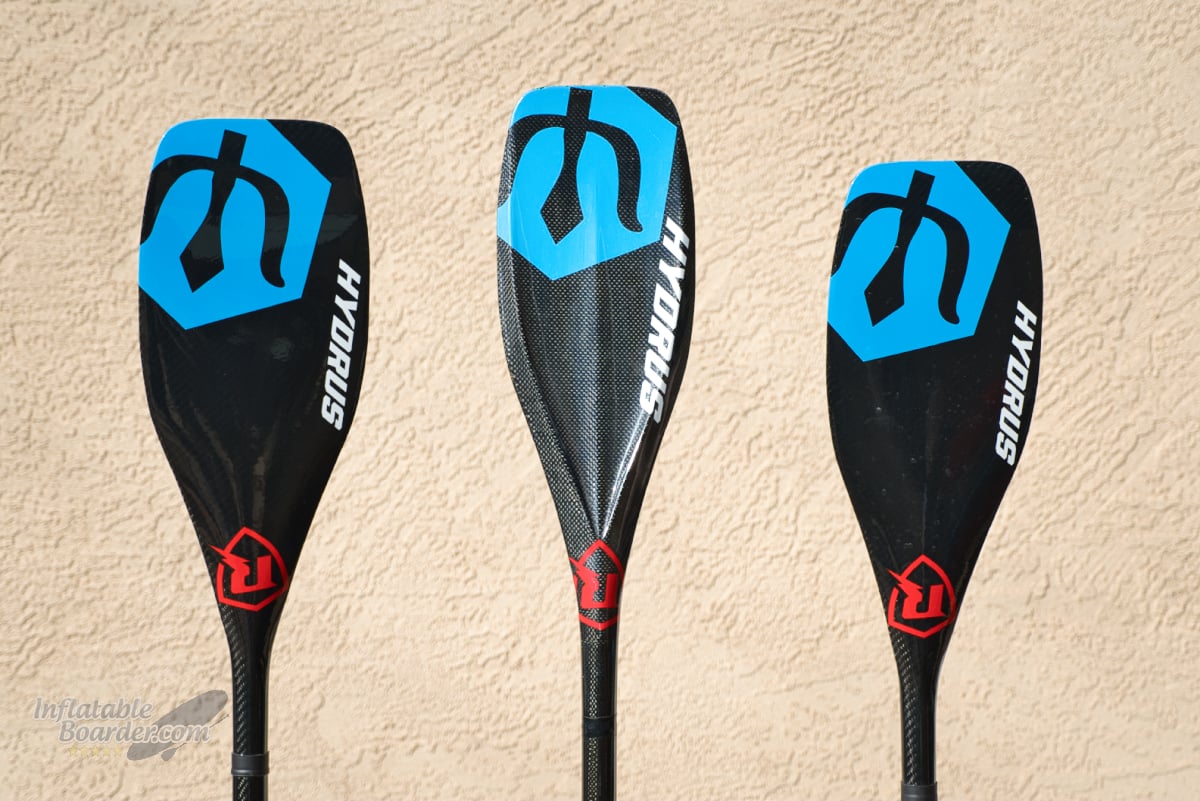
There are two blade sizes available Medium (center) and Large (Left and Right). The blades themselves are the same length, but appear different in this photo due to paddle lengths and alternating front/back orientation.
The two different blade sizes share the same shape (simply scaled for the appropriate width). The medium-size blade is 6 ⅜” wide and has a surface area of 84 square inches. The large-size blade is just over 7” wide and has a surface area of 90 square inches.
I use both sizes. I prefer the Medium size for distance paddling over 5 miles, and I use the Large size for sprints, technical racing, and any distance racing under 5 miles.
If you are a more casual racer or looking for a lighter, higher-performance touring paddle, or if you are only wanting to have one paddle, then I would recommend choosing based on your weight. Paddlers under 180 pounds will feel right at home with the Medium size, while paddlers over 180 pounds will appreciate the extra power from the Large size.
Both blades feature the same double-dihedral power face shape with a slight scoop in the toe. This gives the blade two “pockets” that hold in the water and three ridges that help direct the flow of water to prevent wandering and slipping. The slight curve in the toe gives you instant hold at the start of your paddle stroke.

The Ruckus’s catch is incredibly clean and solid-feeling.
This is the single most effective paddle blade design I’ve used. First and foremost, the blade shape is extremely user friendly and generates the cleanest catch and release I’ve experienced on the water. It actually took me almost my entire first 10k paddle with the Ruckus to figure out what it was that was going so “right” for me. I suddenly realized that I hadn’t had a single paddle slip, flutter, or wander the entire time. I can’t think of any other paddle that has given me that sort of experience so consistently.
The second thing that really impressed me was that even though the Medium blade Ruckus is 4 square inches smaller than my Quick Blade UV88 (which is actually pretty significant for paddle sizing), I was just as fast with either paddle. I did six back-to-back half mile segments on flatwater, alternating which paddle I used and there was no difference in my speed despite the blade size differences.
Comparing the Medium and Large blades of the Ruckus, there is no question that the large blade provides more power and speed. However, smaller paddlers may not be able to maintain that much effort for long periods of time, and ultra-distance paddlers may prefer the softer feel of the smaller blade to reduce body strain during their paddle.
In my comparisons I’ve found that I’m between 0.3-0.5 MPH faster with the large size blade when paddling at a fitness pace (40-50 strokes per minute). But, as I mentioned earlier, if I’m paddling longer distances I do prefer the softer feel of the Medium blade.
Save 10% with code “BOARDER” at checkout

The Ruckus Medium was my stick of choice for the USA SUP National Championship 10k.
I took the Ruckus with me to Detroit for the USA SUP national championship and used it in the 10k race. Those were some extremely challenging conditions with massive boat wakes from shipping barges, current, wind, and rain. But I never had a single problem with the Ruckus. Each stroke was confident in the water.
My only regret is that I didn’t have a Large size Ruckus to use for the technical and sprint races, though the Hydrus Toughblade one-piece paddle did quite well for both!
You can read more about my experience at USA SUP National Championships in my blog post, and you can become a member of USA SUP – and check out your local races – at USASUP.org

The Ruckus comes with your choice of handle size.
Hydrus also offers two different handle sizes with the Ruckus paddle. The standard Medium size is the same size and shape as what comes on the Hydrus Toughblade One-Piece paddle (but no finger divots like on the 3-piece paddle).
The new Large size handle is wider and has a slight concave on the back side, though not as much as on the front for your fingers.
I have relatively small hands, so I find the Medium size to fit me well.
But, having used both I can feel a difference when I switch to the Large size handle, but I forget about it somewhere around the 4th paddle stroke. Hydrus owner Jason prefers it as the larger grip area helps reduce the tendency to over-grip on smaller handles, reducing tendon fatigue in his elbow.
Ultimately, I think most people will be happy with the Medium handle, and those with larger hands or wanting to reduce grip pressure may enjoy the Large handle better.
The two piece paddle uses a custom-made ferrule positioned to allow airline travel.
Lastly, you have the choice of a single-piece paddle cut to your desired length or a two-piece paddle cut to your desired length. There is no adjustable option at this time. If you aren’t entirely sure of what paddle length you want, order the paddle on the longer side. You can always remove the handle and cut the paddle down with some very basic tools at home.
Whether or not to choose the One- or Two-piece will come down to your travel plans. If you have the room for a one-piece paddle when you travel, then that is my recommendation. It saves you a couple ounces in weight.
However, if you plan to fly with your paddle, you should consider the two-piece option. Now, a two-piece paddle will not get as small as a three-piece paddle, so there is a catch here. The two-piece ruckus is cut at around 32” from the blade tip. So your minimum length will be your paddle length minus 32”. For my 76” paddle, that means 44” long. I spoke with Jason at Hydrus about this and how to fly with it since it won’t fit in the Hydrus Mothership bag. His recommendation – and how he flies with his iSUPs anyway – is to use a military-surplus duffel bag for both the board and the paddle (plus some other luggage). These bags fit on all major airlines as checked luggage, are inexpensive, and are very durable.
If I were to offer any suggestions for a Ruckus 2.0 paddle the only thing I’d really want to see is a slightly more tapered shaft. This would have the benefit of both reducing a little bit more weight and providing a little more flex – which would make the Large size blade a more comfortable option for distance racing/paddling.
Save 10% with code “BOARDER” at checkout
Hydrus Ruckus Flyweight: Final Thoughts

The Hydrus Ruckus, Hydrus Elysium Air, and Hydrus Riptide fin make for a high performance combo that can travel anywhere – even competing in the USA SUP National Championships.
I mentioned at the top of the review that Hydrus has once again made me question my previous purchase decisions. Though, to be fair, those were made prior to the Elysium Air and Ruckus being available!
Simply put, the Hydrus Ruckus is the best value in high-performance SUP paddles. It’s not just a good value, but it works really damn well. I’ve used Black Project, Quick Blade, Hippostick, Starboard, and many other paddles in my time, but this one just absolutely takes the cake. It feels amazing in the water with zero flutter, wander, or slipping, and has just the right balance of stiffness, size, weight, and of course cost. It’s not just my new go-to race paddle, it’s my new go-to paddle for everything short of whitewater.
I’m still going to keep my Quick Blade UV88 though; it makes a great backup for my Hydrus Ruckus!
Save 10% with code “BOARDER” at checkout




Leave a Reply