

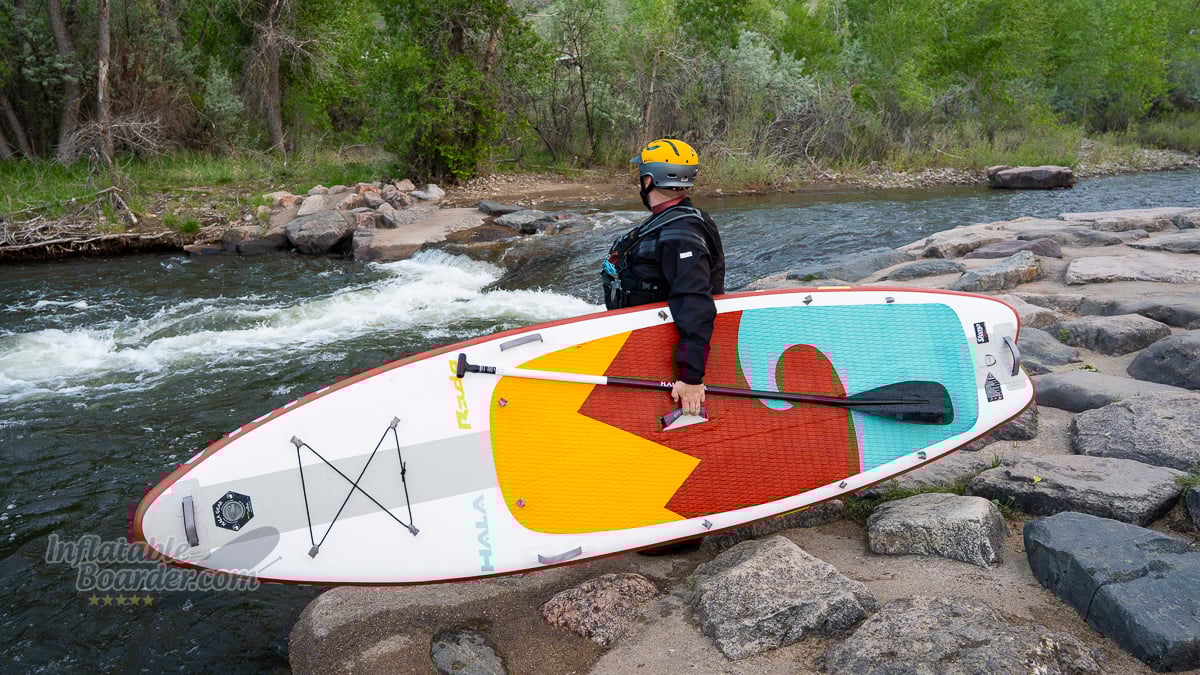
The Hala Rado is built specifically for whitewater expedition trips where you need both high quality performance and extra space and capacity.
Hala Rado Whitewater iSUP Review – Overview
Whitewater SUPs are made to be highly maneuverable and handle large waves and drops – so they are short and rockered. But that doesn’t leave a lot of room on the board. So what do you do when you are gearing up for a multi-day river expedition? You get the Hala Rado.
The Rado is a specialty board of specialty boards. It’s built not just for whitewater, but for whitewater expeditions. The extra length (10’10”) and flatter – but certainly not flat – rocker profile gives you the space and speed you need to send it down that unexplored river on an epic mission, or loaded up with all the pleasantries for a fun overnight trip on your backyard blue lines.
Editor’s Note: Whitewater paddle boards are highly-specialized iSUPs with a very different design and performance profile than boards built primarily for flat water. For our Whitewater SUP reviews we use a separate testing method and scoring scale compared to our all-around and other iSUPs.
Save $50 with code “INFLATABLEBOARD”— Hala Rado Whitewater iSUP Review Ratings and Summary —
Hala Rado Whitewater iSUP
-
Construction & Durability
-
Features and Versatility
-
Stability
-
Agility
-
Control
-
Waves and Drops
Overall Score
The Hala Rado is a purpose-built whitewater expedition paddle board.
Pros
- High quality construction with welded seams for durability
- PVC stiffening stringer for additional rigidity
- Lots of room for multiday river trip equipment
- High rocker profile to easily ride through waves and holes
- StompBox fin system allows you to use full-length fins in shallow water to maintain control without getting tossed
- Super-stable shape with excellent tracking
- Includes flexible fins and wheeled carrying bag
- 5-year warranty
Cons
- The longer shape is not as agile on the river as Hala’s other whitewater SUPs
- Limited cargo space under the built-in front bungee cords
Hala Rado Whitewater iSUP Review – Construction and Durability
The Hala Rado features a woven drop stitch core that enhances rigidity and reduces weight. Its top and bottom layers are made from woven polyester fabric, connected by thousands of drop-stitched yarns that maintain the board’s 6” thickness and keep the layers parallel when inflated.
The outer shell is constructed from reinforced PVC material that is heat-fused directly to the inner core. This bonding method eliminates the need for glue, creating a strong, lightweight, and durable structure without compromising rigidity.

The Hala Rado uses a heat-welded inner seam with a second layer of PVC around the rails.
The inner rail layer is heat-welded to the deck and hull and protected by another layer of PVC material for additional rigidity and durability.
With the board built and all of the features added, the Atcha 96 weighs in at 29.6 pounds including the stompbox fin insert.
At its maximum inflation pressure of 18 PSI, the Hala Rado flexed just 1.1” in our static bend test – putting it in line with some of the most rigid iSUPs we’ve tested. On the water I couldn’t feel any flex or bend when standing, paddling normally, or while running over waves and drops.
Save $50 with code “INFLATABLEBOARD”Hala Rado Whitewater iSUP Specifications
Specifications
| Dimensions | |
| Length | 10’ 10” |
| Width | 35.5“ |
| Thickness | 6“ |
| Weight | |
| Max Capacity | 325 pounds |
| Board Weight | 29.6 pounds |
| Kit Weight (SUP & accessories) | 42 pounds |
| Buying Info | |
| List Price | $1399 |
| Warranty | 5 years |
| Returns period | 30 days |
Hala Rado Whitewater iSUP Review – Features, Accessories and Versatility
The Hala Rado is meant to carry you, and all of your equipment, safely down the river day after day. With plenty of rigging points, you can be sure that your gear can be rigged to flip.

The Hala Rado is 10’10” long, 35.5” wide (as measured), and 6” thick. It weighs 29.6 pounds with the StompBox fin and has a maximum recommended rider weight of 325 pounds. The elongated shape has a flatter midsection which adds to its stability and capacity.

The nose has a broad tapered shape designed to provide stability and capacity, but also paddle a little more efficiently than more aggressive whitewater SUPs.

There are three flat webbing carry handles on the Rado’s nose, center, and tail.

The front cargo area is relatively small, but capable of holding 10-20L dry bags with all of your river essentials. Rather than using steel D-rings, hala uses webbing loops for tie down points to eliminate potential injury when falling on the board. However, as an expedition style board I would like to see this cargo area expanded to help carry equipment more evenly front and back.

There are two additional handles near the front of the deck pad. These grab handles can help you wrangle the board during transport, give you a solid way to hold onto the board in some heavier water conditions, and control the board when you are in the water.

The center carry handle has light padding, but still lies flat to keep it from interfering with moving around on the board. The deck pad has a high-traction diamond groove pattern for secure foot placement.

There are three additional pairs of tie-down points along the back half of the board for securing additional cargo for longer trips.

The deck pad extends almost all the way to the tail of the board with a 1.5” tall kick pad to keep you from accidentally stepping off the back of the board and improve control when lifting the nose or surfing.

There is a raised indexing pad along the midline of the tail to help orient your feet without looking. The tail itself is quite wide with a slight fish tail shape to help improve maneuverability without giving up much stability or capacity.

There are two two-tab/FCS style fin boxes for the Rado’s smaller 4.5” flex fins. Rather than having a typical US fin box, the Rado uses Hala’s removable StompBox fin box system that allows the 9” flex fin to nearly fully retract into the fin box when paddling through shallow water or on forward-impact with rocks and other obstacles. To install the StompBox fin, simply inflate the board with just enough air to give it shape, insert it into the box, and then fully inflate the board. Small blocks and the pressure from the board hold it firmly in place.

The 9” fin retracts almost completely into the board when pressed from the front or bottom, and springs back to its full depth once you pass whatever is pressing on the fin.

The Hala Rado comes with a basic accessory kit, but no paddle.
The Hala Rado kit is designed for more advanced paddlers. As such it only includes the necessities to use the board, but does so with high quality accessories.
Included with the Hala Rado is:
- Hala Rado Whitewater SUP
- Removable StompBox fin box with a 9” surf-style fin preinstalled
- Two 4.5” FCS/two-tab flexible side fins
- Fin key/wrench
- Dual-action hand pump
- Repair kit
- Wheeled, duffel-style transportation bag
The Hala Rado comes with neither paddle nor leash. Paddlers seeking the highest performance paddle boards often either already have a paddle (or paddles) they like for specific uses, or you can add the Hala paddles at a 10% discount when purchasing with the Rado. Leashes on the river can be extremely dangerous, and for most paddlers shouldn’t be used. There are quick release leashes available (including from Hala) for those who do need a leash on longer expedition-style trips. If you are unfamiliar with this leash style or would like to learn more about why standard leg-leashes are extremely dangerous on moving water, check out our blog post about leashes.
Save $50 with code “INFLATABLEBOARD”Hala Rado Whitewater iSUP Review – Paddle
The Rado doesn’t come with a paddle automatically. However, the Hala Grafik paddle makes a great companion for river paddling.

The Hala Grafik paddle has a thermoplastic and carbon fiber blade and lever-lock adjustable handle.
The Hala Grafik paddle is a great match for the Rado. It’s available as a 2-piece adjustable (Grafik) and 3-piece adjustable travel version (Lock & Load Grafik) with the same materials and designs – optimized for river paddling.
The blade balances weight, stiffness, and durability by using a 7-ply blend of composite fibers (primarily carbon fiber) and a thermoplastic resin. This gives you more flex in the blade than pure composite-epoxy blades for impact resistance, but keeps it rigid enough for powerful strokes and strong enough to withstand hitting a few rocks.
I did find that both Grafik paddles I have had a few splinters along the edge of the blade where the unidirectional carbon fibers end (sort of like the end grain of a piece of wood). But, a small piece of 220 grit sandpaper and two minutes later and the paddle edges are smoothed out and ready to rumble.
The paddle shaft and handle sections are made with 3K carbon fiber and has a plastic T-grip at the top to accommodate the lever-lock adjustment system.
There is a printed length scale and indexing mark on the paddle shaft/handle to help you set up your paddle and orient the handle to the blade. The lever lock system uses a rubber stopper at the end of the handle section connected to the grip with a metal wire inside the handle. Opening the lever releases tension on the cable and stopper and allows you to adjust the length and orientation of the handle, and clamping the lever down tensions the whole system for a snug fit. The Lock & Load 3-piece Grafik paddle uses the same type of system to connect the blade section to the shaft.
The lever lock system can need some maintenance and adjustment over time, but the tradeoff is a clean paddle shaft with no protruding levers, buttons, or clamps.
Save $50 with code “INFLATABLEBOARD”Hala Rado Whitewater iSUP Review – Stability
The Rado is the most stable of Hala’s whitewater SUPs. Its larger size, rigid construction, and flatter mid section help it feel rock solid on the water.

The flatter mid section of the board increases its surface area and makes it feel stable, even when heeled over on its rail.
Stability is a critical factor in designing a whitewater SUP, but it has to be balanced with the board’s ability to maneuver and handle sudden changes in elevation. In the case of the Rado, it also has to be able to do all of this while carrying upwards of 40-50 pounds of equipment!
By stretching out the length of the board through the middle, the Rado becomes extremely stable for a whitewater SUP. There’s no twitching, rolling, bobbing, or any other -ing while paddling the board down river, upriver, or across the river.
The listed weight capacity of 325 pounds is a maximum rider weight, but the overall capacity of the Rado is much higher. This helps keep the stability consistent even when loaded up for a long trip.
There are a few tradeoffs for this extra capacity and stability – primarily with agility which we cover in the next section.
Overall, the Hala Rado is the most stable whitewater SUP I’ve used.
Save $50 with code “INFLATABLEBOARD”Hala Rado Whitewater iSUP Review – Agility and Control
For expedition paddling, the ability to carry what you need and make expedient progress down river takes precedence over maximizing agility, and so it is with the Hala Rado.

The 9” fin and longer shape make the Rado more difficult to turn quickly without lifting the nose.
Let’s start with agility. Quick maneuverability in the river is a hallmark of a whitewater SUP. The Hala Rado is capable of quick maneuvering when shifting your weight back toward the tail, but when standing in the middle of the board (as you would when it is fully loaded), it can be a different story.
The longer waterline and 9” fin work together to keep the Rado moving straight almost a little too well at times. In order to turn quickly I found myself scrambling to make big cross-bow maneuvers using my entire body where a board like the Hala Atcha 96 would spin around with a basic forward sweep or stern draw. It definitely takes some getting used to if you are coming from a more typical whitewater SUP – even from the Hala Radito.

Almost hitting my photographer early in our shoot day when the Rado didn’t carve as expected.
I actually nearly took out my photographer during our photo shoot because of this! Coming down the first drop of the day on the Rado (after having been on the Atcha 96 and Radito earlier), I didn’t anticipate how much the board would drive straight through the eddy below the wave rather than carving into it like the other boards. The photo above was taken at a 24mm focal length – which means that the nose of the board was something like a foot away from smacking the camera out of his hand!
There is plenty of space and stability at the tail of the board to step back for snappy pivot turns (and the Rado does turn quick with its nose lifted), but if you are packed up for an overnight, you won’t have that luxury.
Hala does offer a smaller fin for their StompBox system, so you may want to pick one up if you are planning on running rivers that will require lots of tight maneuvering.

The Rado can ferry and paddle upriver like a dream.
The flip side here is that the Rado’s shape makes it excellent for quick downriver progress, ferrying across the current, and even attaining back upstream.
That longer waterline and deeper fin help direct the board in a straight line while paddling. That means less effort tracking straight and more speed no matter which direction you are paddling on the river. I found it very easy to attain back upstream and to ferry across the current.

TThe 9” retractable fin gives the Atcha 96 more control than a typical 1+2 fin setup in a whitewater board, but can sometimes force the board to point more up or downstream than you want.
Hala’s StompBox fin system does a great job of keeping the Rado on track and making sure you don’t take a header off the board if you run through shallow water.
The center fin box fits in a recess built into the board and is fully removable when the board is deflated (but held securely when inflated). The fin is held in place on a spring-loaded mechanism that allows it to fold back into the fin box when you paddle through shallow water or over a submerged object.
Having the fin fold into the board like this lets you use a longer fin for better tracking, but keeps you, the fin, and the fin box safe from most impacts. The system is on a one-way spring, so if you are drifting backward, it can still catch.
The Rado also comes with two 4.5” flex fins for the FCS/two-tab fin boxes on either side of the board. You can keep these fins in for maximum tracking, or take them out to help give you a little more maneuverability.
Save $50 with code “INFLATABLEBOARD”Hala Rado Whitewater iSUP Review – Waves, Drops, and Surfability
It’s stable, it’s got room for your gear, but how well does this extra large whitewater SUP handle the rapids?

Turning the Angler Core is easy and quick, even with basic sweep strokes.
The Hala Rado is built to take on big water. While it’s not as rockered as the Hala Atcha 96 – arguably the most aggressive whitewater SUP available – the Rado has plenty of curves where it counts.
The front nose rocker starts quite a ways back on the board (just in front of the deck pad) and has a clean, progressive arc to the semi-pointed nose. The mid section of the board is mostly flat, but only for about three feet of length, then the tail rocker begins to curve the tail of the board up as well. The tail rocker is one of the biggest design differences in the Adventure series (Rado and Radito) compared to the Charge series (Atcha 96 and 86). It does slightly reduce the overall whitewater capability of the board, but gives it that improved stability, speed and tracking. Of course, this is all relative. It’s still more rockered than just about any all-around SUP on the market!
Paddling over some Class II waves and drops felt almost like paddling on flat water. The nose rocker keeps the front of the board up while the rest begins to crest over the drop, and then the tail rocker keeps things level as it drops down into the wave. When the board was too long to cleanly come up and over the wave crest, the pointed nose pierced through cleanly and without any jolting or slowing down.
While the Atcha 96 is going to be a great choice for the most technical bits of whitewater, the Rado is still a highly capable whitewater SUP for typical Class III and big water Class IV+.
Save $50 with code “INFLATABLEBOARD”Hala Rado Whitewater iSUP Review – Warranty and Customer Support
Hala Gear offers a 5-year warranty for their inflatable paddle boards. If you have any issues with your Rado, call up the customer care team in Steamboat, CO (or drop by if you are in the neighborhood) and they’ll take care of you. Paddles and other accessories are warrantied for one year from the date of purchase. Hala does have a 30-day return period, however it is for new, unused, products only. If you have any questions about Hala, their boards, or a warranty issue, you can contact them via website chat, email, phone, at their HQ, or through social media.
Save $50 with code “INFLATABLEBOARD”Hala Rado Whitewater iSUP Review – Final Thoughts

The Hala Rado is a whitewater-worthy expedition SUP built for adventure.
The Rado is a specialist’s specialty board. It’s built specifically to handle big trips and big water, and it works fantastic for that. It’s not what I would recommend if you are looking for a generalist whitewater SUP (like the Hala Radito) or a more technically-acute whitewater SUP (like the Hala Atcha 96), But it is, without a doubt, still a high-performance whitewater board.
If you are looking for a whitewater expedition and multiday river SUP, the Hala Rado has everything you need.
Save $50 with code “INFLATABLEBOARD”



Leave a Reply